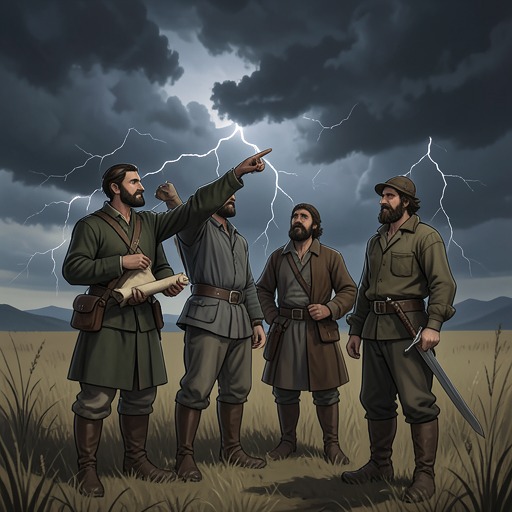
Wang Ping
The Romance of the Three KingdomsWang Ping is a Shu commander repeatedly defined by sound judgment under pressure. His clearest early test comes at Jieting, where he recognizes the danger in Ma Su’s plan, argues for defending the road, and reports the divided positions to Kong Ming. When the position collapses, he helps resist the consequences of Ma Su’s mistake and assists the retreat. Across later campaigns, he remains an experienced officer entrusted with difficult operations, including the seizure of Yinping and the defense of a mountain pass against a much larger Wei force.
Command and Field Experience
During Kong Ming’s southern campaign, Wang Ping is among the commanders entrusted with the main attacking force. Kong Ming appoints younger officers to lead it while presenting Wang Ping and Zhao Zilong as old and unfamiliar with the region. The two veteran commanders, dissatisfied with this treatment, gather information from captured locals and devise their own approach to the enemy camps. Their night attack helps break the coordinated position of the three tribal armies: Zhao Zilong strikes the camp of Jinhuansanjie, while Wang Ping attacks Dongtuna’s force from the rear. The younger commander Ma Zhong attacks from the front. Dongtuna escapes, but his army is defeated. This episode shows Wang Ping’s initiative and local intelligence at work, even as his actions intersect with the plan Kong Ming has set in motion.
Wang Ping also joins operations in difficult terrain during the same southern campaign. When a detachment sent to explore the route through Bald Dragon ravine drinks from a deadly spring and is told that its members may die within a week or two, Kong Ming investigates how the army might proceed. The incident underscores the environmental hazards facing the force and the need for practical knowledge as well as command decisions. Wang Ping is not credited with discovering the remedy, but his role in the ravine episode places him among the officers exposed to the campaign’s severe conditions.
Jieting and the Limits of Book Learning
After Meng Da’s death alters the military situation, Kong Ming assigns troops to defend Jieting against Sima Yi. Ma Su volunteers for the task, although his experience is largely theoretical, and Kong Ming sends Wang Ping to oversee him. At Jieting, Wang Ping advises defending the road, the route the enemy must use. Ma Su rejects this counsel and instead chooses a hill, believing its elevated position will give him a better view. He supports his decision with citations from Sun Zi’s Art of War and dismisses Wang Ping’s objections rather than treating them as operational warnings.
As the enemy closes in, Ma Su permits Wang Ping to take a small force to guard the road while he remains on the hill. Wang Ping sends Kong Ming an express report describing their different positions. That report gives Kong Ming direct information about the deployment, but it cannot repair the decision already made. Sima Yi attacks after learning that the inexperienced Ma Su commands the defense. Ma Su’s troops are cut off on the hill, where the lack of water worsens their position and desertions begin. Wang Ping tries to come to their aid but is driven back. Ma Su eventually leads his men down in an attempt to fight through, and Zhang He pursues them.
Wang Ping’s work continues during the withdrawal. Wei Yan’s rescue force is drawn into an ambush, and Wang Ping saves him at the last moment, though the Shu force suffers heavy losses. Sima Yi captures Jieting, and a later effort to retake it also fails: the Shu troops enter what appears to be an empty town and are caught by surprise. The account distinguishes Wang Ping’s judgment from Ma Su’s error without making him able to prevent every defeat. His advice is sound, but his authority is limited; his report, defensive detachment, and rescue action mitigate the disaster rather than avert it.
Later Northern Campaigns
After Kong Ming captures Chencang, the Shu army takes San Pass to prevent Wei reinforcements from reaching the city. From the plains beyond the Qishan hills, Kong Ming sends Jiang Wei to capture Wudu and Wang Ping to seize Yinping. Wang Ping’s assignment places him among the commanders extending Shu control through coordinated operations rather than holding a single defensive position.
When Wei later prepares a major invasion, Kong Ming summons Wang Ping and Zhang Ni in Chengdu and orders them to defend a pass with only a thousand men. The proposed force is strikingly small beside the four hundred thousand troops advancing under Cao Zhen, Sima Yi, and Liu Ye. Wang Ping and Zhang Ni are skeptical, asking how such a small contingent could stop so vast an army. Kong Ming answers that he has read the night sky as foretelling many days of heavy rain, which would damage the enemy’s morale and make an advance up the rain-soaked mountains difficult. The defense is thus presented as part of a larger plan: the small force is to hold the pass while Kong Ming prepares a main army to strike the Wei troops during their retreat. Wang Ping’s presence at this assignment reflects the confidence placed in him for a position where terrain and timing matter as much as numbers.
A Practical Counterpoint in the Narrative
Wang Ping’s principal characterization rests on a recurring contrast between experienced observation and untested confidence. At Jieting, he identifies the road as the position that needs defending, while Ma Su’s theoretical certainty leads him to choose the hill. The difference is expressed through consequences: Wang Ping communicates the actual deployment, attempts to help when the enemy closes in, and later rescues Wei Yan, but he cannot overcome the larger failure created by Ma Su’s decision.
His later roles broaden that portrait without turning him into an invincible commander. He gathers intelligence and attacks an enemy camp during the southern campaign, receives responsibility for Yinping, and is named to defend a pass against a far larger invasion force. These episodes keep him within the collective structure of Kong Ming’s campaigns: a field officer whose practical competence supports plans shaped by terrain, information, and timing. The evidence does not give him a separate personal ending; it leaves him serving in the continuing military effort of Shu.